Engineered to Evaporate: The Studio Science of Making Movies Nobody Hates (or Remembers)
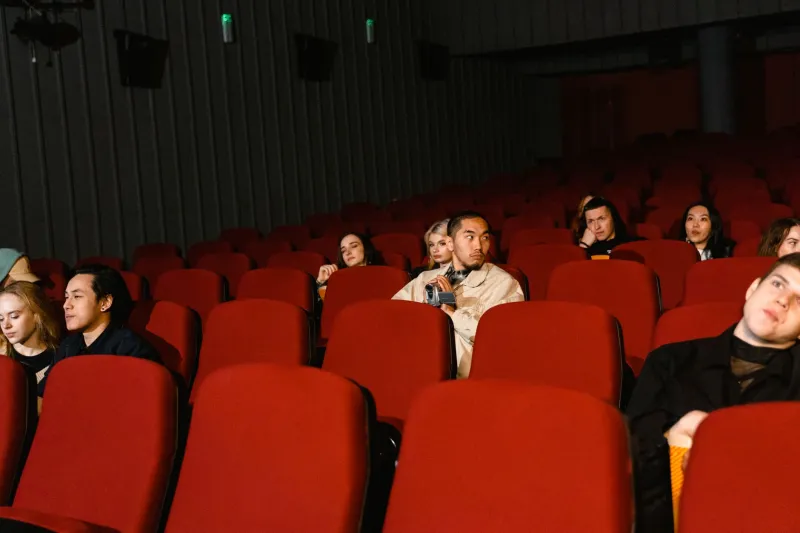
Somewhere in a conference room that smells like recycled air and anxiety, a focus group just saved a movie from itself. The villain's monologue got trimmed because test audiences in the Midwest found it "too intense." The protagonist's morally compromised decision — the one that actually made her interesting — got reversed in reshoots because a demographic bracket between 18 and 34 marked it "confusing." The ending, once genuinely ambiguous, now closes on a swell of strings and a look that says: everything is fine, you can go home.
Congratulations. The movie is ready.
This is the quiet machinery behind the modern blockbuster, and it's running at full capacity. Hollywood has spent the last decade and a half perfecting what might generously be called the science of cinematic neutrality — the art of constructing a film so carefully calibrated across demographics, international markets, and algorithmic taste profiles that it registers as entertainment to virtually everyone and as something genuinely felt by almost no one.
The Focus Group Industrial Complex
Let's be clear about what test screenings actually are in 2024. They're not about improving a film. They're about sanding down its edges until nothing sharp remains. Studios live and die by tracking data, and that data rewards safety. A film that scores a 72 across all four quadrants — male, female, under 25, over 25 — is a green light. A film that scores a 91 with one group and a 48 with another is a problem to be solved, usually by removing whatever caused the 91 in the first place.
The result is a generation of movies built for the median. Not the best version of themselves. The least objectionable version.
Think about the last time a major studio release genuinely surprised you with a character choice. Not a plot twist engineered to make you gasp — those are still in the toolkit, they test well — but a real, uncomfortable, human decision that made you sit with something unresolved. It's getting harder to remember, isn't it?
Sandpaper Cinema
There's a specific texture to these films once you learn to feel for it. Dialogue that used to have a point of view now has a stance. Characters who once had contradictions now have arcs so clean they could've been generated by a story algorithm — and in some cases, frankly, they were. Conflict exists but resolves cleanly. Ideology is present but never implicating. Everyone is flawed in ways that are ultimately charming.
The MCU is the obvious target here, and it's a fair one — but it's also too easy. The homogenization runs deeper than franchise filmmaking. Look at the prestige-adjacent studio pictures, the ones with awards ambitions and serious faces on the poster. Even those have started arriving pre-diluted. A film about addiction that never makes you complicit. A war movie that condemns atrocity from a safe distance. A story about race in America that makes white audiences feel like they've done something by watching it.
The discomfort is performed. The challenge is aesthetic. The movie is, at its core, agreeable.
The International Market Did This (Partly)
You can't talk about this without talking about China — or more accurately, about the decade when Hollywood was desperately chasing Chinese box office returns and restructuring entire narratives to accommodate censorship requirements and cultural sensitivity demands from that market. Characters got rewritten. Storylines about government corruption vanished. Queer subtext, always already coded to begin with, got coded even harder into invisibility.
That pipeline has cooled significantly. But the instinct it trained into studio development culture didn't leave with it. The habit of imagining a global audience so vast and so varied that any genuine specificity becomes a liability — that's baked in now. It's institutional reflex.
And here's the part nobody wants to say out loud: the American domestic market has started demanding the same frictionlessness. Streaming metrics reward rewatchability, which rewards comfort. The algorithm that surfaces content to you on a Tuesday night isn't looking for what will challenge you. It's looking for what will keep you from closing the app.
What Gets Lost in the Dilution
Here's the thing about offense, about genuine provocation, about a movie that makes someone in that focus group squirm: it means the film is doing something. It means it made contact.
The history of American cinema that actually matters is a history of films that pissed people off. Midnight Cowboy won Best Picture and was rated X. Do the Right Thing didn't even get nominated and it's one of the most important American films ever made — in part because it refused to let anyone off the hook. Chinatown ends in a way that still feels like a gut punch because Polanski (and yes, we can hold complexity here) understood that resolution is sometimes a lie the movies tell you.
None of those films would survive a modern focus group intact. All of them are the reason cinema matters.
When you engineer a movie to offend nobody, you are also engineering it to move nobody. Emotion requires stakes. Stakes require the genuine possibility of loss, wrongness, ugliness. A film that has been processed to remove every element that might alienate a portion of its audience has also removed every element that might make another portion of its audience feel genuinely seen.
The Forgettability Paradox
The supreme irony of the inoffensive blockbuster is that the studio's investment in broad palatability actively undermines the thing that actually drives long-term revenue: cultural staying power. People don't buy the merchandise, rewatch the film, or show up for the sequel because a movie was agreeable. They do it because the movie meant something to them.
The Dark Knight made a billion dollars and people still argue about it. Joker was controversial as hell and grossed over a billion. These are not accidents. Edge and specificity and genuine artistic risk create the kind of audience investment that no amount of four-quadrant testing can manufacture.
Meanwhile, the carefully calibrated, thoroughly inoffensive tentpole from two summers ago? You remember it was fine. You remember the visual effects were decent. You do not remember a single line of dialogue.
Cinema That Commits
What we're really talking about is commitment. A movie that commits to a point of view, to a character's darkness, to an ending that doesn't reassure you — that movie is making a bet. It's saying: we think this is worth something, even if it costs us a segment.
That's not a reckless artistic impulse. That's just filmmaking. That's what the medium is supposed to do.
The studios have convinced themselves that risk aversion is sophistication. That the ability to model audience response and smooth out the rough patches is craft. It isn't. It's fear dressed up in data. And the movies it produces aren't cinema. They're content — functional, consumable, and gone from your memory before you've finished the drive home.
Make something that offends somebody. Make something that makes the focus group uncomfortable. Make something that doesn't know how to be everything to everyone because it's too busy being something to someone.
That's the four-letter word the studios forgot.